Get to know some of the New River Gorge’s most fascinating native plants—and learn how people have used them for food, medicine, craft, and culture throughout the ages.

White Baneberry
It’s Latin name is Acetaea pachypoda, but we call it Doll’s Eyes. | Our Doll’s Eye Video
The name “baneberry” comes from the Old English word “bana,” meaning “killer” or “slayer,” so it should come as no surprise that this unusual plant is toxic. The colloquial name of “doll’s eyes” is self-explanatory.
Baneberry’s pea-size fruits develop in late summer and mature throughout early fall. The berries extend from the stem on thick stalks which turn a vivid red, providing stark contrast to the bright white fruits. The flower stigmas form a dark dot at the center which makes them look like doll’s eyes.

Pokeberry
Its Latin name is Phytolacca americana, but we call it poke. | Our Pokeweed Video
All parts of the plant are toxic to humans and many animals, especially the roots and seeds. But birds love these beautiful berries and can pass a seed without breaking down the hard coating which is one of the reasons the plant is so widespread.
Regardless of the toxicity, old timers often ate the young shoots and leaves after boiling them, then dumping the water and boiling them again. They called it poke sallet (not salad) and consumed it as a spring tonic. It was belied to cleanse the body after a long, cold, vitamin deprived winter.

Sycamore Tree
Its Latin name is Platanus occidentalis, but we call it ghost of the gorge | Our Sycamore Tree Video
Several years ago, we started noticing that our favorite sycamore trees seemed to be reacting to the sweltering summer temperatures by shedding copious amounts of bark. We’d find hundreds of thin, smooth pieces of bark at the bottom of each tree.
Turns out this exfoliation is a completely normal part of a sycamore’s growth process. Its rigid bark can’t stretch to accommodate the tree’s growing size, causing it to crack and peel off in large flakes. The white under bark that remains stands out during the day and glows in the moonlight.

Sassafras
Its Latin name is Sassafras albidum, but we call it sassy-fras. | Our Sassafras Video
Sassafras is easy to spot because of its unusual leaf shapes. It has THREE: un-lobed, bi-lobed and tri-lobed. Nowadays, sassafras is often considered a weed tree, but in the past the tree was prized for its delicious flavor (used in teas and root beer) and medicinal power (a popular spring tonic).
So, what changed? Sassafras oil was BANNED by the FDA in 1960 in all commercially mass-produced foods and medicines due to concerns about safrole, a major component of sassafras oil that was found to cause liver damage and cancer.
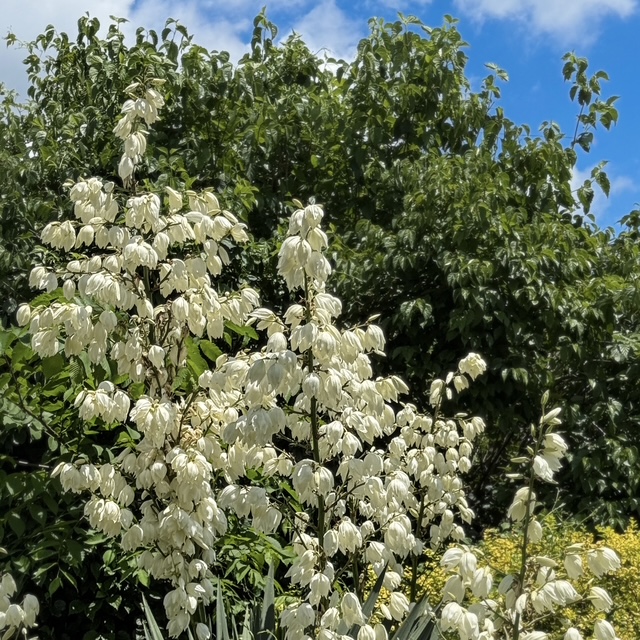
Yucca Plant
Its Latin name is Yucca filamentosa, but we call it Adam’s needle or simply yucca. | Our Yucca Video
In the past, yuccas were used as grave markers by folks who could not afford or were not allowed gravestones, such as poor or enslaved people. There are several reasons why: 1. The plant stands out in the Appalachian and Southern environments. 2. Yuccas live an EXCEPTIONALLY long time. 3. They are hard to kill – or even get close to – which discourages people from removing it.
Surprisingly, Yucca filamentosa is native to the southEAST, including West Virginia. But they prefers sandy soil, so it’s uncommon to see them in our forests or on our hillsides. Our native Yucca is a close relative of the huge Century Plants that grow throughout the southWEST (where it looks a little more at home).

Witch Hazel
Its Latin name is Hamamelis virginiana, but we call it witch hazel. | Our Witch Hazel Video
Unlike most trees, witch hazel blooms in late fall — sometimes into December — and the new flowers share the same branch with the fruit. (Its Latin name, Hamamelis, literally means “together with fruit.”) Its flowers offer a last sweet snack for bees, flies, and moths before winter sets in.
Folks once believed that this tree had supernatural abilities. Its forked branches were used to find underground water — a practice called water-witching or dowsing. The witch in witch hazel may come from the Old English word for practitioner of wicca, or from wiche which means “to bend,” describing how the stick would mysteriously dip toward hidden springs.
Follow us on Instagram for more information about the fascinating plants that grow in this Appalachian Forest.
Who are we? Amy & Shawn, New River Gorge hikers, master naturalists, and owners of Lafayette Flats Boutique Vacation Rentals in downtown Fayetteville, WV.
If you enjoyed this post you might also like: